5 SHTF Guns Worth Stockpiling Before 2027!
5 SHTF Guns Worth Stockpiling Before 2027
Not chosen for looks. Not chosen for impressiveness. Chosen because when the ecosystem around you disappears — these are the platforms still answering for themselves.
Why Most SHTF Gun Lists Get It Completely Wrong
Most “best SHTF guns” lists are built around one question: what is the most capable firearm? That is the wrong question.
Capability in isolation means nothing when your supply chain fractures, your support network disappears, and you are operating across five different contexts simultaneously. The correct question is: which firearms feed the same logistics chain, fill distinct operational roles, and remain serviceable without factory support?
You are not building one system. You are building five — a handgun, a vehicle kit, a home defense position, a pack you carry for days, and a long-range solution. Every system pulls from the same magazine pool, the same ammunition cache, the same muscle memory. The wrong platforms fight each other. The right ones feed each other.
“Survival has never been about owning the most impressive gun. It’s about choosing the right tool before you actually need it.”
Every rifle on this list was evaluated across four axes: logistics integration, durability under irregular maintenance, ecosystem depth, and role clarity. What follows is that thinking applied — five roles, five platforms, and the real reasons behind every choice.
Ruger PC Carbine Chassis
Logistics Consolidation · Vehicle Kit · Home Defense
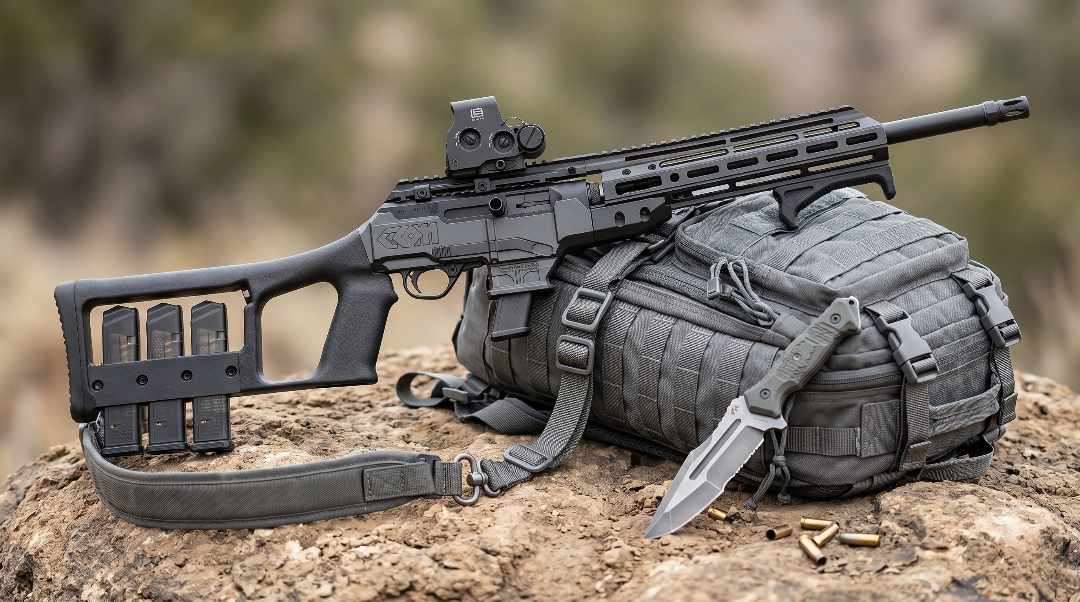
| Spec | Detail |
|---|---|
| Caliber | 9mm Luger |
| Weight | 6.3 lbs unloaded |
| Folded Length | 16.25 inches |
| Barrel | 16.12 inches |
| Effective Range | Up to 150 yards |
| Accuracy | Sub-2″ groups at 50 yards |
| Magazine Compatibility | Glock-pattern (15–33 round) |
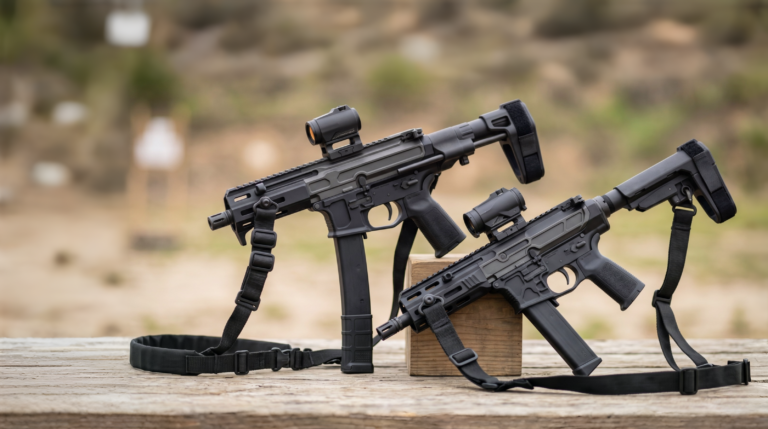
Most people judge this platform by what it isn’t. They compare it to rifle platforms, see a pistol-caliber carbine, and miss the entire point. The PC Carbine was never trying to be a rifle. It was designed to solve the multi-platform logistics problem that most preparedness conversations never reach.
The real value starts with caliber. Nine-millimeter is the most widely stockpiled pistol cartridge on earth. If your sidearm is a Glock, the PC Carbine draws from the exact same magazine pool — same capacity, same source, zero duplication. That is not a convenience feature. That is a strategic logistics decision that eliminates an entire supply chain vulnerability.
The chassis folds to just 16.25 inches, engineered to fit inside the same bag already holding everything else. The carbine-length barrel adds 300–400 fps over a typical handgun barrel, meaningfully improving terminal performance out to 150 yards.
Compared to the Kel-Tec SUB-2000 — the closest competing platform — the Ruger wins decisively on build quality under sustained use and on magazine compatibility. Any armorer who has run both under high-round-count conditions will tell you it is not close.
Strengths
- Shares mags and ammo with Glock sidearms
- Folds to 16.25″ for any pack or vehicle kit
- 9mm availability is unmatched globally
- Significantly more durable than Kel-Tec SUB-2000
- Low recoil, fast follow-up shots under stress
Limitations
- 9mm effectiveness drops past 150 yards
- Not a substitute for rifle-caliber platforms at range
- Blowback action less efficient than locked-breach designs
Bottom Line
If your sidearm is already a Glock, the PC Carbine turns your pistol’s logistics chain into a two-platform system without adding a single caliber. Nothing in its class touches it for vehicle kits, home defense, and pack carry.
Ruger Mini-14
.223 Remington · Low Visual Profile · 50-Year Service Record
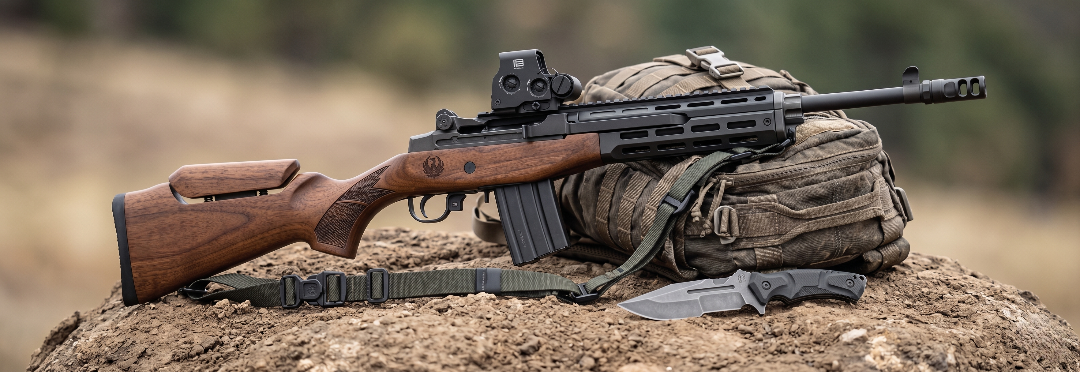
| Spec | Detail |
|---|---|
| Caliber | .223 Remington / 5.56 NATO |
| Weight | 6 lbs 9 oz unloaded |
| Overall Length | 37.25 inches |
| Barrel | 18.5 inches |
| Effective Range | 300 meters |
| Capacity | 20 rounds standard |
| Action | Fixed-piston gas, rotating bolt (M14-derived) |
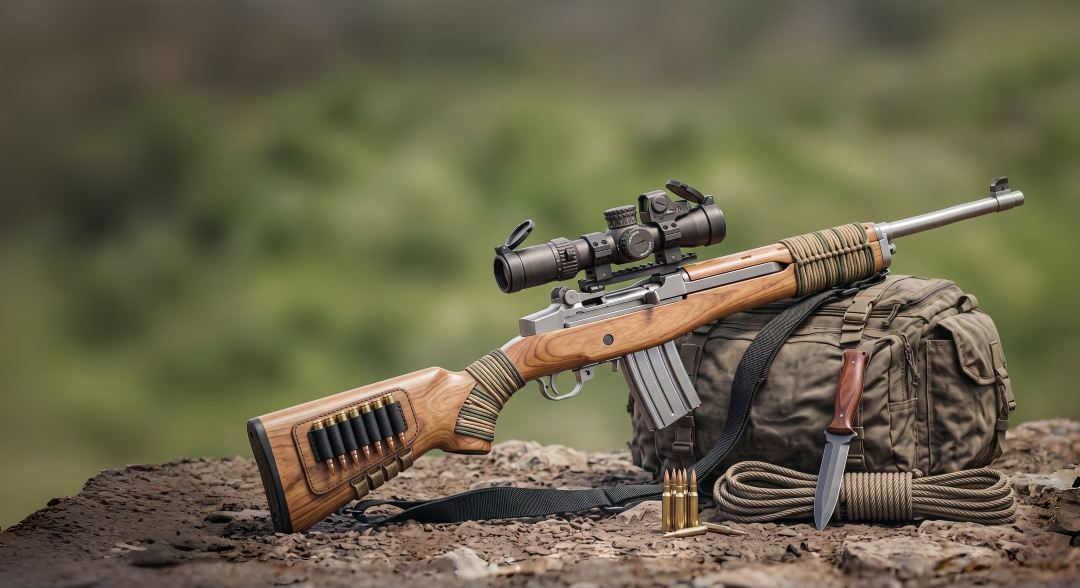
The engineers who designed the Mini-14 in 1973 were working from a different brief. They were not building the most impressive rifle on the rack. They were building one that could exist in the widest possible range of social environments without changing how those environments responded to its presence.
The Mini-14 cycles .223 Remington through a platform that visually reads as a ranch rifle — something unremarkable. In periods of documented social instability, unremarkable is a survival characteristic no tactical specification can replicate. It was adopted by law enforcement agencies, prison systems, and border patrol across North America specifically because of this dual-character trait: serious defensive capability inside a low-alarm social footprint.
The 18.5-inch barrel maintains meaningful .223 velocity out to 300 meters. The fixed-piston gas system runs reliably under the irregular maintenance conditions that extended field use actually produces — no obsessive lubrication schedule required. Twenty rounds of deliberate, accurate fire from something nobody identified as a threat beats thirty rounds from something that immediately escalated every environment around it.
Strengths
- Reads as a sporting rifle — critical in social instability
- Fixed-piston gas: reliable under poor maintenance conditions
- Shares .223/5.56 ammo with the BCM RECCE-16
- 50+ year law enforcement adoption record
Limitations
- Less precision potential than AR-pattern at distance
- Smaller aftermarket parts ecosystem than AR or AK
- Heavier trigger than a tuned AR
Bottom Line
When visibility itself creates risk, the Mini-14’s ability to project calm is a survival asset no ballistic specification can replace. It is the quiet platform in your system — the one that operates in environments where declaring yourself armed has costs you cannot afford.
Arsenal SAM7R
Milled AK-Pattern · 7.62x39mm · Bulgarian Military Spec
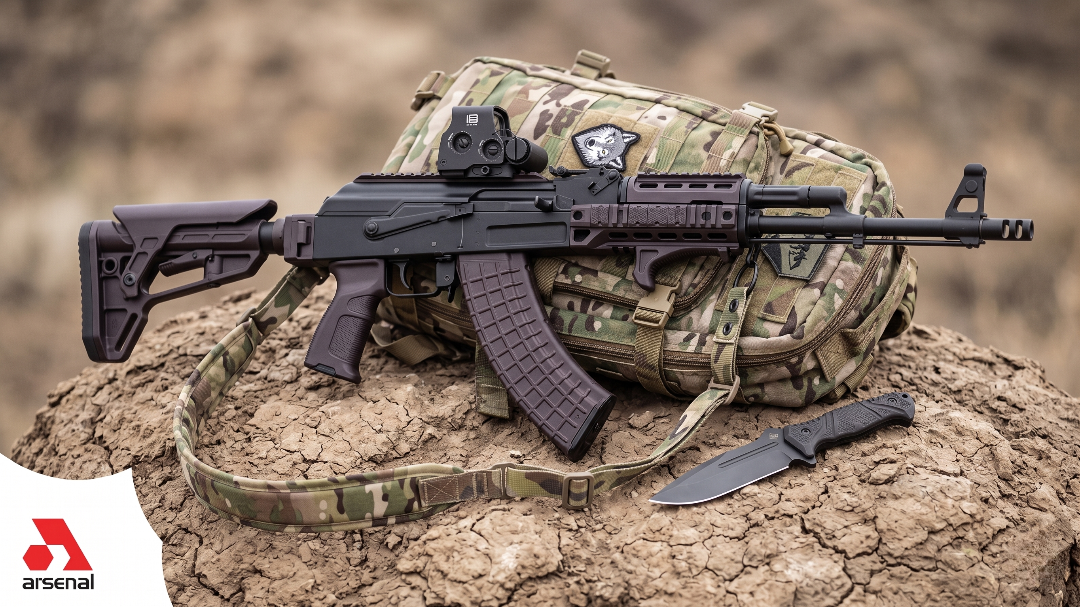
| Spec | Detail |
|---|---|
| Caliber | 7.62x39mm |
| Weight | 8 lbs 2 oz unloaded |
| Receiver | Milled from single billet steel |
| Barrel | Chrome-lined, hammer-forged |
| Capacity | 30 rounds standard |
| Temp Range | –40°C to +50°C military acceptance standard |
| Malfunction Rate | <1% in institutional sustained-fire testing |
Every documented instance where armed populations operated without institutional support shows the same pattern. The platforms that kept functioning were not the most sophisticated. They were the ones with the fewest moving parts, the most forgiving tolerances, and the deepest informal knowledge base for keeping them running with whatever was locally available.
The Kalashnikov pattern has appeared in that endurance role across more documented instability scenarios than any other firearm design in modern history. What Arsenal did with the SAM7R is take that pattern and build it to a standard that closes the gap between field-grade reliability and precision-grade execution — without compromising a single element of what made the original survive everything thrown at it.
The SAM7R uses a milled receiver — not stamped. Machined from a single billet of steel, milled receivers offer greater rigidity under sustained cycling and dimensional stability that stamped-receiver variants cannot match over a long service life.
Bulgarian military acceptance standards require each barrel to pass functional testing from negative 40 to positive 50 degrees Celsius. That specification is the foundation behind the SAM7R’s documented institutional malfunction rate of under one percent across sustained fire cycles. That is the number that closes the endurance argument.
Strengths
- Milled receiver — greater durability than stamped alternatives
- 7.62x39mm is globally manufactured and deeply stockpiled
- <1% malfunction rate in sustained institutional testing
- Reliable across extreme temperature ranges
- Massive global knowledge base for field maintenance
Limitations
- 8.2 lbs is heavier than 5.56 alternatives
- 7.62×39 ballistics limit effective precision past 400m
- Adds a third caliber to the system logistics chain
Bottom Line
When you need a platform that will still function after years of irregular maintenance, in conditions no other rifle was built to tolerate, drawing from the most globally distributed intermediate cartridge on earth — the SAM7R is the endurance answer.
Springfield M1A
.308 Win / 7.62 NATO · 800-Yard Authority · 60+ Years in Production
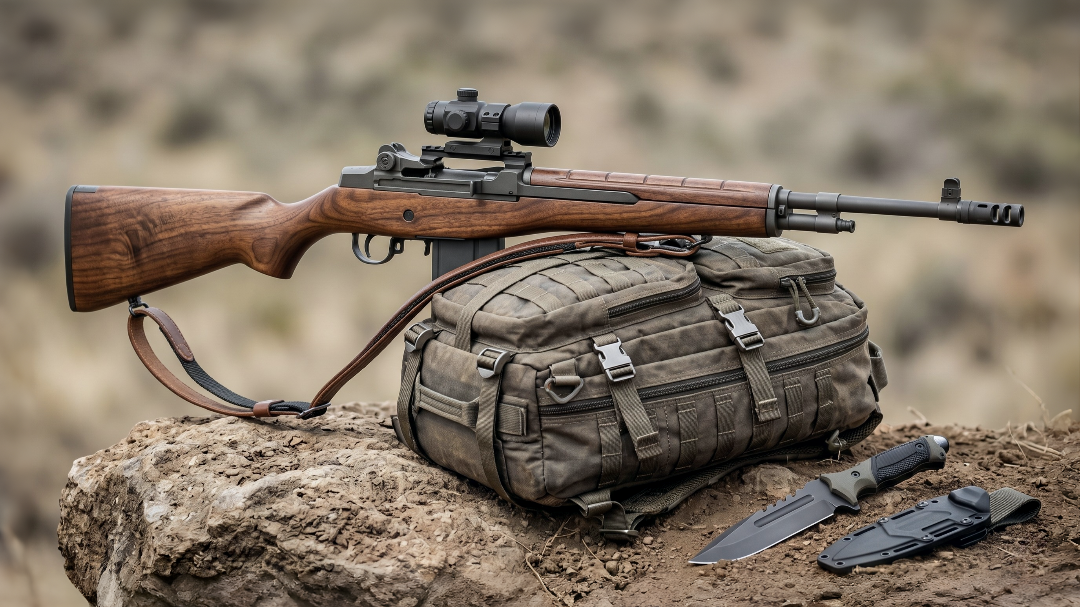
| Spec | Detail |
|---|---|
| Caliber | .308 Winchester / 7.62×51 NATO |
| Weight | 9 lbs unloaded |
| Barrel | 22 inches |
| Effective Range | 800+ yards with retained terminal performance |
| Capacity | 20 rounds standard |
| Action | Gas-operated, rotating bolt (M14-derived) |
| Production History | 60+ years continuous production |
You are on day four. The weight across your shoulders stopped being theoretical somewhere around mile eight of day two. Right now, with a ridgeline in front of you and a situation developing at distance, you are either holding a platform that can reach out and change what happens — or you are not.
The Springfield M1A exists for the person who understood, before they ever needed it, that distance is not a ballistic consideration. Distance is a strategic one.
The M1A is Springfield’s commercial evolution of the U.S. M14 — America’s primary battle rifle from 1959 through 1970, never fully retired because nothing has genuinely replaced what it does at range. The 22-inch barrel lets the .308 Winchester reach full velocity potential — arriving at 800 yards with enough retained energy to be genuinely decisive. That is the range where the side that can reach and the side that cannot inhabit fundamentally different realities.
Nine pounds unloaded is a real carry commitment. But it represents a battle-proven gas system, an M14-derived rotating bolt, and over 60 years of continuous production — meaning the knowledge base for maintaining this platform without factory support is one of the deepest in American firearms history. Trained armorers, documented protocols, and communities of experienced users exist wherever the M1A exists.
Strengths
- 800-yard effective range with decisive .308 terminal performance
- 60+ year production history — vast knowledge and parts base
- M14-derived action proven across all U.S. military branches
- .308 / 7.62 NATO is NATO-standard, globally stocked
Limitations
- 9 lbs is the heaviest platform in this system
- Ammunition is heavier and more expensive per round than 5.56
- 20-round capacity is lower than AK or AR alternatives
Bottom Line
No other platform in this system reaches out and changes outcomes at 800 yards. That role belongs exclusively to the M1A. If your preparedness plan does not include distance authority — before contact happens — it has a critical gap. This fills it.
BCM RECCE-16
5.56 NATO · Mil-Spec Execution · 20 Million Platform Ecosystem
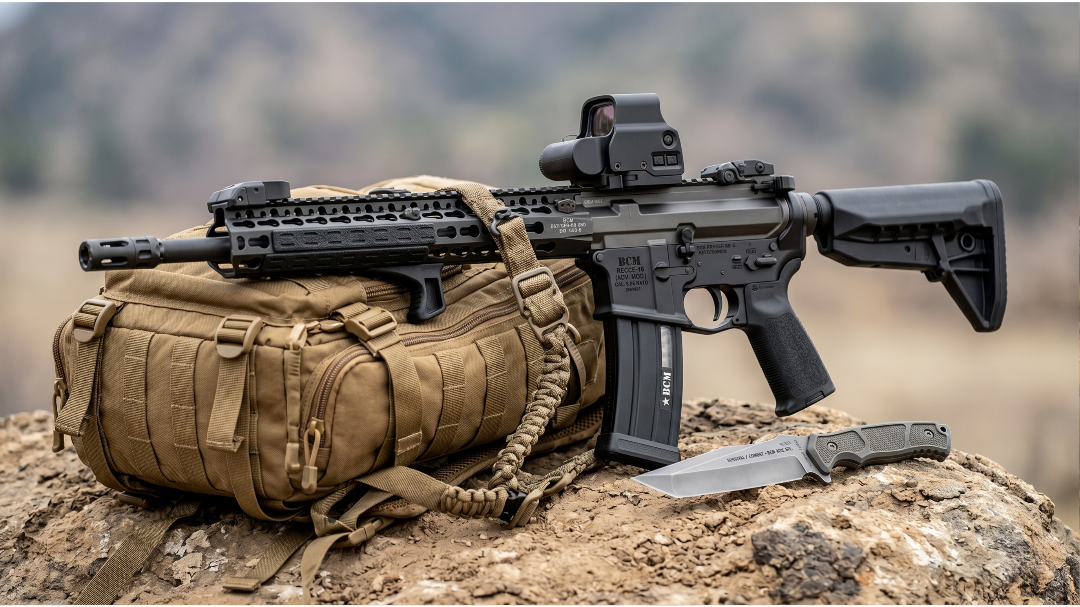
| Spec | Detail |
|---|---|
| Caliber | 5.56×45 NATO |
| Weight | 6 lbs 10 oz unloaded |
| Barrel | 16″ hammer-forged, chrome-lined |
| Gas System | Mid-length (optimized for 16″ barrel) |
| Effective Range | 500 meters |
| Capacity | 30-round PMAG |
| BCG Testing | Magnetic particle inspected + high-pressure tested |
| Civilian Ecosystem | 20+ million AR-pattern rifles in U.S. civilian hands |
Here is the ecosystem fact almost nobody in the preparedness space names explicitly: there are over 20 million AR-pattern rifles in civilian hands in the United States alone. That means there is not a single populated county in the country where a trained armorer, compatible spare parts, or a working knowledge base is more than a short drive away.
The AR-pattern ecosystem does not merely exist — it is everywhere simultaneously, with no single point of failure. No other rifle platform in human history has achieved this level of distributed redundancy in a civilian context. This is a documented sociological reality with direct implications for long-term operational continuity.
BCM built the RECCE-16 to the standard that professional evaluation units demand. The 16-inch, hammer-forged, chrome-lined barrel delivers mil-spec execution at the optimal balance point for a 16-inch platform. The mid-length gas system extends barrel, bolt, and BCG service life compared to carbine-length alternatives.
The bolt carrier group is magnetic particle inspected and high-pressure tested at the factory — not as an upgrade, but as the standard baseline. These are the quality controls that separate a platform built for the ecosystem role from one that merely occupies it. When parts sourcing goes through unknown channels, tight tolerances mean any legitimate AR-pattern component functions without adjustment.
The 30-round PMAG — adopted by more agencies than any other polymer magazine design — is the most widely stocked detachable box magazine on earth. The BCM RECCE-16 did not simply benefit from the largest civilian arms ecosystem on earth. It helped build the standard that ecosystem runs on.
Strengths
- 20M+ platform ecosystem — parts and armorers everywhere
- Mil-spec BCG: MP-inspected + HP-tested as standard
- Mid-length gas system extends component service life
- 5.56 NATO is the most globally stockpiled intermediate rifle cartridge
- 30-round PMAG is the most widely adopted polymer mag on earth
- 6 lbs 10 oz — lightest rifle-caliber platform in this system
Limitations
- 5.56 terminal performance degrades past 500 meters
- Direct-impingement requires more consistent maintenance than piston alternatives
- Premium price vs. budget AR alternatives
Bottom Line
When the ecosystem around you is the only support structure left, the platform embedded in that ecosystem’s architecture wins. The BCM RECCE-16 helped build the standard it runs on. Nothing at this role delivers comparable parts depth, armorer availability, and quality control consistency.
Full Platform Comparison
All five platforms evaluated across the axes that matter for long-term operational continuity.
| Platform | Role | Caliber | Weight | Effective Range | Ecosystem Depth |
|---|---|---|---|---|---|
| BCM RECCE-16 | Ecosystem / Primary | 5.56 NATO | 6 lbs 10 oz | 500 m | Deepest (20M+ rifles) |
| Springfield M1A | Distance Authority | .308 / 7.62 NATO | 9 lbs | 800+ m | Very Deep (60+ yrs) |
| Arsenal SAM7R | Endurance | 7.62x39mm | 8 lbs 2 oz | 400 m | Deep (global AK base) |
| Ruger Mini-14 | Presence Management | .223 / 5.56 | 6 lbs 9 oz | 300 m | Moderate |
| Ruger PC Carbine | Integration | 9mm Luger | 6.3 lbs | 150 m | Moderate (growing) |
The 5-Role Survival Loadout Framework
Owning all five platforms is the end state, not the starting point. Build sequentially — each role fills a gap the others leave open.
Role 1 · Ecosystem
BCM RECCE-16. Acquire first. Build your 5.56 ammunition, PMAG, and spare parts cache around this foundation.
Role 2 · Distance
Springfield M1A. Second priority. Begin a separate .308 stock. The 500m-to-800m gap is the one nothing else in the system covers.
Role 3 · Endurance
Arsenal SAM7R. Third priority. A modest 7.62×39 cache — the SAM7R’s role is long-term reliability, not volume fire.
Role 4 · Presence
Ruger Mini-14. The platform for environments that respond to visual signals before ballistic ones. Shares .223 with your BCM stock.
Role 5 · Integration
Ruger PC Carbine. Acquire last — or early if your sidearm is already Glock-pattern. Shared magazines mean the logistics chain is partially built already.
Common Questions Answered
Daniel Defense produces excellent rifles. BCM wins on two SHTF-relevant axes: quality control consistency across high production volume, and depth of professional adoption. When sourcing a replacement BCG from an unknown source in a degraded environment, the platform with the most consistent tolerances wins. BCM’s MP-inspected, HP-tested BCGs have been independently verified by professional end-users over a decade of production.
Yes. Both chamber .223 Remington / 5.56 NATO. The BCM RECCE-16 uses a 5.56 NATO chamber that safely accepts both cartridges. The Mini-14 Ranch Rifle also accepts both. Your 5.56 stockpile feeds two platforms simultaneously — a deliberate logistics advantage built into this system.
Within its honest 150-yard effective range — yes. The carbine barrel adds 300–400 fps over a pistol barrel, meaningfully improving terminal performance. The real strategic value is logistics consolidation: if your handgun and carbine share the same magazines and caliber, you have eliminated one of the most critical supply chain vulnerabilities in a multi-platform system.
Both will function reliably. The milled receiver offers greater dimensional rigidity under sustained cycling and better barrel fitment over time — directly relevant for a platform chosen for its endurance role, where it may need to function for years without factory service. The SAM7R’s Bulgarian military acceptance testing is the most rigorous QC process applied to any AK-pattern rifle available to U.S. civilians.
Start with the BCM RECCE-16. The 20-million-platform ecosystem it operates within provides more logistical resilience than any other single choice. Build a meaningful ammunition stock (2,000+ rounds minimum), 10–15 PMAGs, and a basic spare parts kit — bolt, firing pin, extractor, cam pin. Add the Springfield M1A second to fill the distance role.
A minimum of 1,000 rounds per primary platform, with 2,000–5,000 as a more resilient baseline for long-duration scenarios. The PC Carbine sharing a caliber with your 9mm sidearm means that stock covers two platforms simultaneously. For the M1A’s .308, 500–1,000 rounds is a meaningful starting baseline. Rotate stock regularly to maintain primer viability.
The Framework Is the Point
You came into this breakdown looking for the right survival rifle. What you are leaving with is something more important — a framework. Five distinct roles. Five deliberate platforms. And the understanding that survival preparedness has never been about owning the most impressive firearm in the room.
It is about choosing the right tool before you need it, building a logistics chain that feeds itself rather than fights itself, and recognizing that the ecosystem surrounding your platform is as strategically important as the platform itself.
The BCM RECCE-16 earns the top position not because it is the most powerful rifle here, but because it is the most connected — the platform most deeply embedded in the largest civilian arms ecosystem ever assembled. When support infrastructure disappears, connectivity is the capability that remains.
The M1A gives you distance. The SAM7R gives you endurance. The Mini-14 gives you presence without declaration. The PC Carbine consolidates your logistics. Together, they form a complete system.
“Every platform choice is a bet on a specific future. Build a system, not a collection.”
Which survival role do you think most people completely ignore when building their setup? Drop your answer and your current loadout in the comments.